Forex Trading for Beginners: A Complete Starting Guide
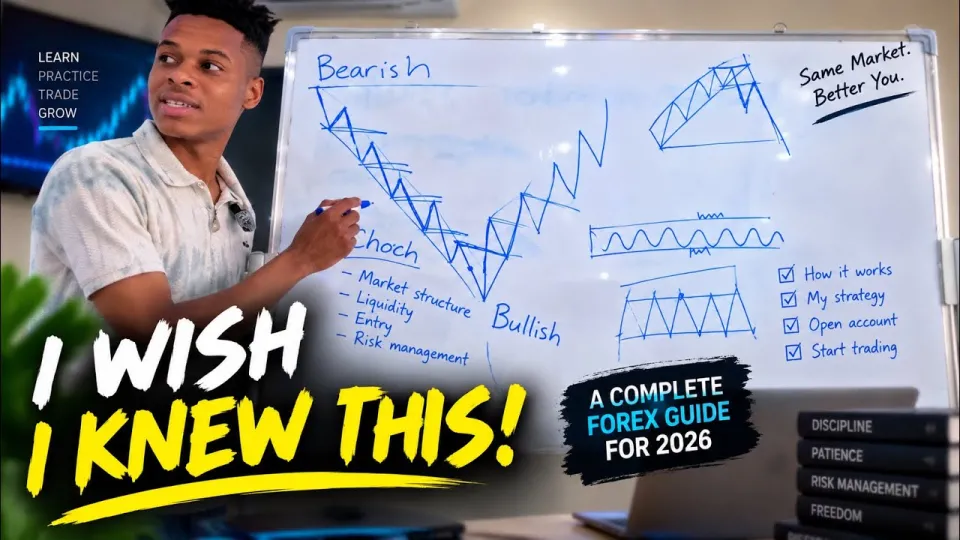
Video: How To Start Forex Trading For Beginners in 2026 (Full Guide + My Strategy)
Want articles like this for your own video to promote it on YouTube and Google? Order them through the Telegram bot @sat_sit_bot. Articles with your video embedded are written and posted by the bot itself — on popular topical sites (no ads). Free trial — 50 articles.
Forex trading for beginners starts with understanding the market, opening a brokerage account, and mastering basic concepts like market structure and risk management. This guide distills the essentials from Carl Fx's full beginner walkthrough, giving you a clear path to start trading with confidence. To open a live account with the broker featured in the video, visit TFC Global Markets registration.
What Is Forex and How Does It Work?
Forex, or foreign exchange, is the global marketplace for trading national currencies against each other. It operates over-the-counter (OTC) through a network of banks, brokers, and electronic platforms, 24 hours a day, five days a week. The most traded pairs include EUR/USD, USD/JPY, and GBP/USD, with daily volume surpassing $7 trillion. Prices fluctuate based on supply and demand, influenced by economic data, interest rates, and geopolitical events. Unlike stocks, forex has no central exchange, and trading occurs via brokers who provide leverage and liquidity.
Getting Started: Opening Your Trading Account
Opening a forex trading account is straightforward: choose a regulated broker, complete registration, verify your identity, and fund your account. Many brokers offer demo accounts for practice. In the video, Carl Fx recommends TFC Global Markets, where you can sign up through his link. Here's a step-by-step approach:
- Research brokers – ensure they are regulated and offer competitive spreads.
- Open a demo account – practice with virtual money until you're consistent.
- Complete verification – provide ID and proof of address.
- Fund your account – start with a small amount you can afford to lose.
- Download a trading platform – MetaTrader 4 or 5 are industry standards.
Understanding Market Structure and Price Action
Market structure refers to the pattern of higher highs and higher lows in an uptrend, or lower highs and lower lows in a downtrend. Recognizing these patterns helps traders align with the dominant trend. Price action analysis focuses on candlestick formations and chart patterns to predict future movements. For example, a bullish trend is confirmed when price breaks above a previous high and retraces to form a higher low. Key concepts include support and resistance levels, trendlines, and candlestick patterns like engulfing bars or pin bars. Mastering these basics allows traders to make informed decisions without relying on complex indicators.
A Simple Trading Strategy for Beginners
A simple yet effective strategy combines trend identification with support/resistance and candlestick confirmation. Follow these steps:
- Identify the trend – use higher timeframes (e.g., daily) to determine if the market is bullish or bearish.
- Mark key levels – draw support and resistance zones where price has previously reversed.
- Wait for a setup – look for a bullish candlestick pattern (e.g., hammer) at support in an uptrend, or a bearish pattern at resistance in a downtrend.
- Enter the trade – place a buy order after confirmation, with a stop-loss below the recent swing low.
- Set a take-profit – target the next resistance level or use a risk-reward ratio of at least 1:2.
This strategy emphasizes patience and discipline, avoiding impulsive trades.
Common Mistakes Traders Should Avoid
Many beginners fall into traps that can wipe out their accounts. Overleveraging is a major pitfall—using too much borrowed capital amplifies losses. Overtrading, or entering too many positions out of boredom or greed, leads to poor decisions. Ignoring risk management, such as not using stop-loss orders, can result in significant drawdowns. Additionally, lacking a trading plan and failing to keep a journal prevents learning from mistakes. Emotional trading, driven by fear or euphoria, often results in buying at highs and selling at lows. Successful traders stick to a strategy, manage risk, and continuously educate themselves.
Addressing Viewer Questions and Concerns
Viewers often ask about starting with a demo account, overcoming the challenge of opening a real account, and grasping complex concepts. Many beginners feel overwhelmed by market structure and price action, but breaking them down into simple steps helps. A common concern is the fear of losing money; starting with a demo account and risking only 1-2% per trade on a live account mitigates this. Some viewers request chart examples, which can be found in Carl Fx's video and other educational resources. The key is to practice consistently and not rush into live trading before building confidence.
Useful Links
Final Thoughts
Forex trading offers opportunities but requires education, discipline, and risk management. Start with a demo account, learn market structure, and practice a simple strategy before going live. Remember that trading is a marathon, not a sprint—focus on consistent improvement. For a comprehensive video guide, check out Carl Fx's channel, where he breaks down these concepts in detail. To get started with a live account, use the TFC Global Markets sign-up link.
Key takeaways
- Forex is the world's largest financial market, with daily trading volume exceeding $7 trillion.
- Beginners should start with a demo account to practice without risking real money.
- Understanding market structure—higher highs and higher lows for uptrends—is key to reading price action.
- A simple strategy combining trend identification and support/resistance levels can help new traders enter trades.
- Risk management, such as risking only 1-2% per trade, is crucial for long-term survival.
Questions & answers
How much money do I need to start forex trading?
You can start with as little as $100 with many brokers, but it's advisable to begin with a demo account and only risk what you can afford to lose. Some brokers require a minimum deposit of $10-$50, but the key is to focus on learning first.
Is forex trading risky for beginners?
Yes, forex trading carries significant risk due to leverage and market volatility. Most beginners lose money initially, so proper education, risk management, and practice on a demo account are essential before trading with real capital.
Can I trade forex part-time?
Absolutely. Many traders trade part-time by focusing on higher timeframes (like 4-hour or daily charts) and using pending orders. It requires discipline and a clear strategy but can be done alongside a full-time job.
What is the best strategy for forex beginners?
A simple trend-following strategy using support/resistance and candlestick patterns is often recommended. It involves identifying the trend, waiting for a pullback to a key level, and entering with a stop-loss and take-profit. Practice this on a demo account until consistent.
Source: How To Start Forex Trading For Beginners in 2026 (Full Guide + My Strategy) · Markdown version